
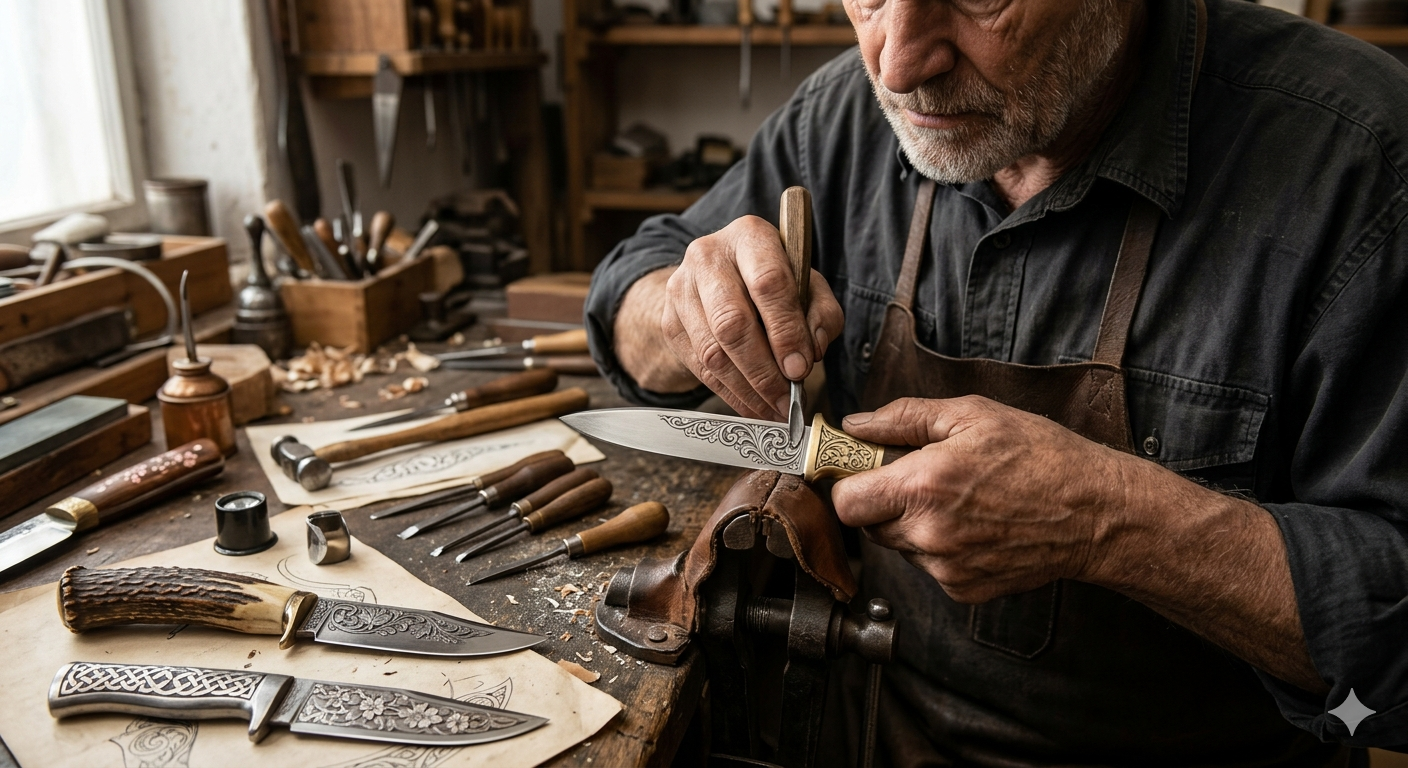
Engraving on blades is one of the oldest forms of decorative art. It turns a functional tool into a cultural artifact — something that carries history, identity, and craftsmanship in every cut line.
Where Did Blade Engraving Begin?
The earliest known engraved blades date back over 5,000 years. Ancient Egyptian craftsmen decorated ceremonial daggers with hieroglyphic inscriptions and geometric patterns, marking ownership and divine protection. Bronze Age artisans across the Near East used simple chisels to cut linear motifs into copper and bronze blades — not for beauty alone, but to signal status.
In ancient Rome, legionary blades sometimes bore the maker’s mark and unit insignia. These weren’t decorative flourishes. They were functional identifiers in a military system that valued accountability.
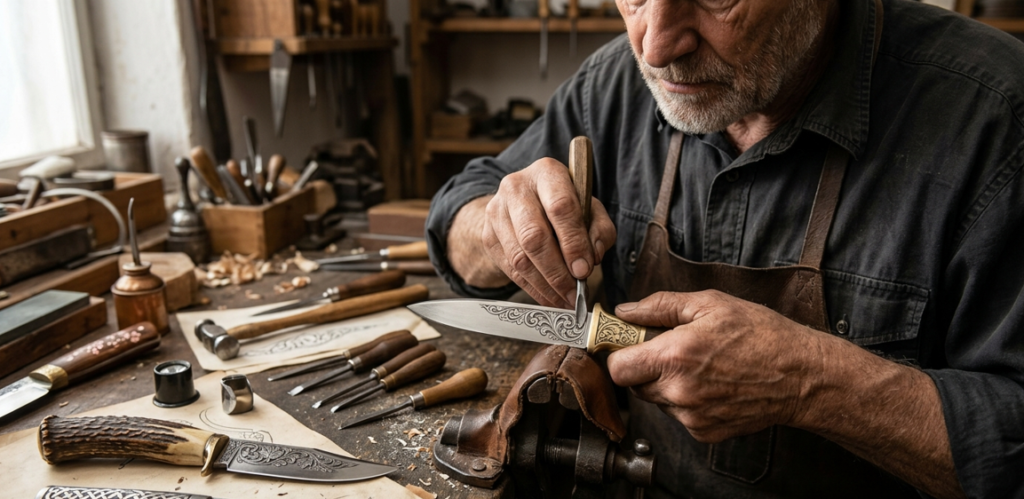
How Did Different Cultures Shape Their Own Engraving Traditions?
Every major civilization developed a distinct visual language for blade decoration. Understanding these traditions helps collectors identify origin, period, and authenticity at a glance.
Islamic tradition produced some of the most technically demanding blade engraving in history. Damascene work from Syria — particularly from the 12th through 16th centuries — combined deep relief cutting with gold and silver inlay (a technique called koftgari). Quranic verses ran along the fuller of sabers, blending spiritual meaning with aesthetic precision. A well-documented example is the collection held at the Topkapi Palace Museum in Istanbul, where Ottoman blades show continuous arabesque patterns covering the entire flat of the blade.
Japanese tradition took a different path. Engraving on Japanese blades (horimono) was restrained and symbolic. Dragons, Buddhist deities, and Sanskrit characters (bonji) were carved into the blade near the tang. The carving was never purely decorative — each motif carried specific protective or spiritual meaning. A hi (blood groove) was sometimes carved not for weight reduction, as commonly believed, but to house a deity’s image. According to the Token Bijutsu journal published by the Society for the Preservation of Japanese Art Swords, fewer than 15% of surviving Edo-period blades carry horimono, making them significantly rarer and more valuable.
European tradition diverged sharply by the Renaissance. Italian and German bladesmiths began using acid etching alongside hand engraving to create elaborate hunting scenes, heraldic crests, and mythological figures on sword blades and hunting knives. The Solingen workshops in Germany — active since the 14th century and still operating today — became the center of European blade decoration. Their guild records from the 1600s document specialized engravers (Ätzer) who worked exclusively on decorative commissions.
Core Engraving Techniques: What Separates One Style From Another
| Technique | Origin / Era | Tools Used | Visual Result | Key Tradeoff |
| Hand engraving (bulino) | Italy, Renaissance | Graver, hammer | Fine lines, portraits, high detail | Extremely time-intensive; one error ruins the piece |
| Acid etching | Europe, 16th century | Acid bath, resist wax | Broad tonal areas, scenic compositions | Less tactile depth; surface can degrade over time |
| Koftgari inlay | Persia/India, medieval | Chisel, gold wire | Gold/silver patterns on dark steel | Requires two separate skill sets: engraving and inlay |
| Horimono carving | Japan, Kamakura period | Specialized chisels | Deep symbolic relief cuts | Structurally alters the blade; irreversible |
| Scrimshaw-style | American frontier, 19th c. | Needle, ink | Fine stippled imagery on bone/ivory handles | Limited to handle materials; not on steel |
Choosing hand engraving (bulino) for maximum detail means accepting that a single piece can take 40–80 hours of work. That’s the honest cost. Acid etching covers more surface area faster, but the tradeoff is shallower visual impact and vulnerability to corrosion if the protective finish fails.
“When evaluating an engraved blade, flip it under raking light — light coming in at a sharp angle. That’s how you see the actual depth and consistency of the cuts. Shallow, uniform lines often indicate machine-assisted work. True hand engraving shows micro-variations in depth that no pantograph can replicate.”
The American Tradition: A Younger but Distinct School
American blade engraving developed primarily through two channels: the frontier Bowie knife tradition and the custom knife movement of the 20th century.
Bowie knives from the 1830s–1860s were often engraved by silversmiths rather than bladesmiths. The handles — frequently made from silver, ivory, or staghorn — received the most decorative attention. Patriotic motifs, eagles, and state seals were common. A documented example: a presentation Bowie knife made for Sam Houston around 1840, now held at the San Jacinto Museum of History, features engraved silver fittings with Texas star motifs and the owner’s name in script.
The modern American custom knife movement, formalized with the founding of the American Bladesmith Society in 1976, brought engraving back into serious focus. Makers like Ron Lake and Bob Loveless began collaborating with dedicated engravers, treating the knife as a complete art object rather than a decorated tool.
A closer look: what the records actually show
- The oldest engraved iron blade currently documented is the Luristan dagger from western Iran, dated to approximately 1000 BCE, featuring geometric hatching along the spine.
- Acid etching on European blades was first recorded in Nuremberg guild documents around 1500 CE — roughly 50 years before it became widespread in Solingen.
- The bulino technique, now associated with Italian gunmakers like Fabbrica d’Armi Pietro Beretta, was originally developed for copper plate printmaking before bladesmiths adopted it in the 17th century.
- In Japanese blade appraisal (kantei), the presence of horimono by a known carver can increase a blade’s auction value by 30–60% according to records from Token Bijutsu auctions held in Tokyo between 2015 and 2022.
- The Solingen Blade Museum (Deutsches Klingenmuseum) holds over 10,000 decorated blades, making it the largest reference collection for European engraving styles in the world.
Think of hand engraving like analog photography in a digital age. The process is slower, less forgiving, and demands complete commitment from the craftsman. But the result carries something that mechanical reproduction cannot fake — the physical record of a human decision made thousands of times across a single surface.
“Collectors often focus on the blade, but the handle engraving tells you more about the period and region of origin. Handle materials and their decoration were subject to local trade routes and material availability in ways that blade steel was not. A knife with a Persian blade and an Indian-engraved ivory handle is a document of trade history, not just craftsmanship.”
How Do You Recognize Quality Engraving Today?
Evaluating engraved knives comes down to three observable factors:
- Line consistency — Quality hand engraving shows controlled variation. Lines swell and taper intentionally. Machine work looks uniform under magnification.
- Background preparation — In high-end work, the background is textured (matted) to create contrast with polished raised elements. Flat, unworked backgrounds suggest lower-tier execution.
- Design integration — The best engraving is designed for the specific blade geometry. Patterns follow the curves of the ricasso, the taper of the blade, the contour of the bolster. Generic designs applied without regard to the knife’s shape are a red flag.
What Does This Mean for Collectors and Makers?
Regional traditions aren’t just historical footnotes. They’re a practical identification framework.
- Arabesque scrollwork with gold inlay on a curved blade points toward Ottoman or Mughal origin
- Deep relief Buddhist imagery near the tang suggests Japanese work, likely pre-Meiji
- Hunting scenes with fine crosshatching on a European hunting knife indicate German or Austrian origin, likely 18th–19th century
- Bold patriotic motifs on silver fittings with an American-style clip-point blade suggests mid-19th century frontier work
For makers, understanding these traditions means understanding what visual language you’re working within — or deliberately departing from. Every engraving choice is a cultural statement, whether intentional or not.
Blade engraving has survived 5,000 years not because it makes knives more functional. It survives because it makes them meaningful. That’s a distinction worth understanding before you buy, collect, or commission one.
For further reference: the Firearms Engravers Guild of America (fega.com) maintains a registry of active engravers and educational resources. The Deutsches Klingenmuseum in Solingen (klingenmuseum.de) offers one of the most comprehensive online archives of European blade decoration.