
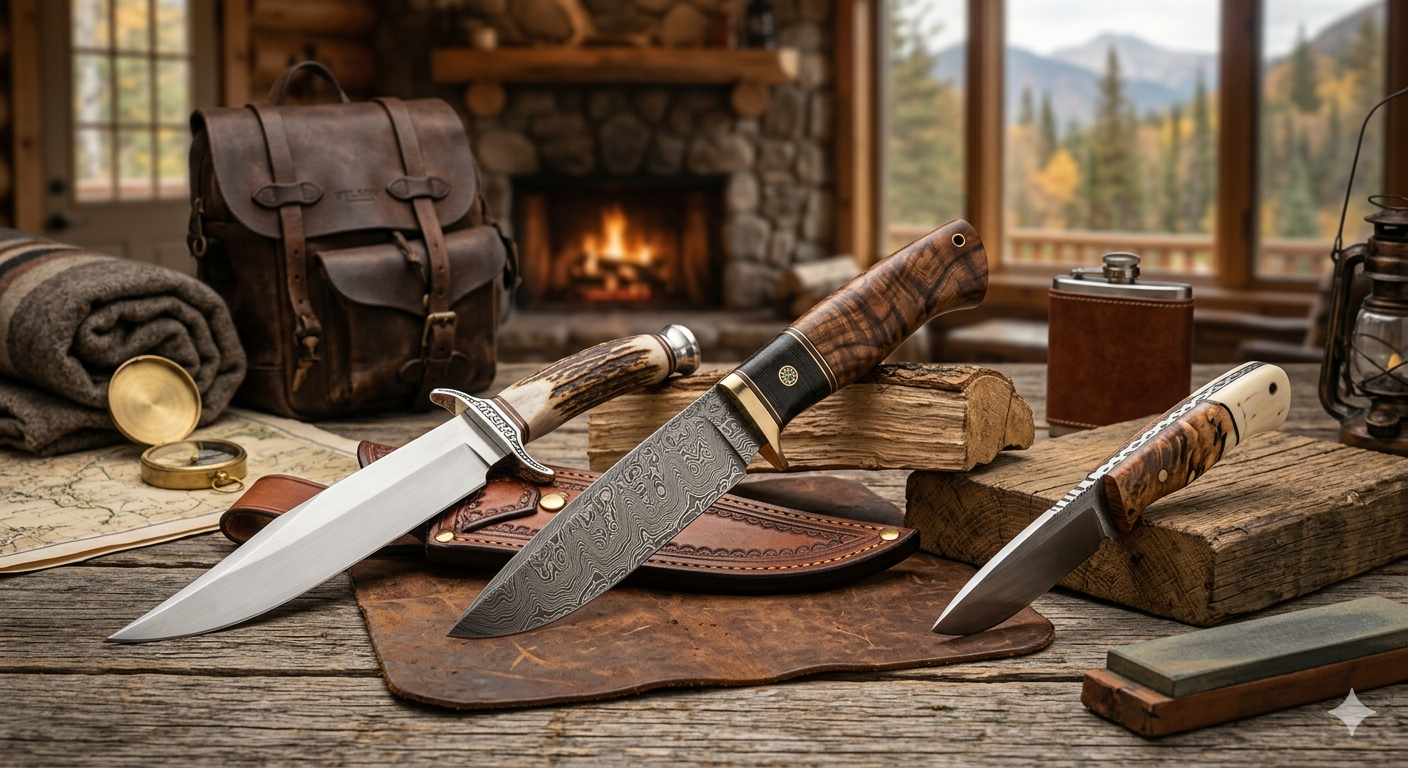
What Makes a Collectible Knife Worth the Investment?
A truly collectible blade is defined by three things: the quality of its steel, the skill of the maker, and its rarity. When all three align, you get an object that holds — and often grows — in value over time, while remaining a fully functional tool in the field.
This isn’t like buying a watch or a pen. A premium knife carries a different kind of weight. It was shaped by hand, heat-treated to precise tolerances, and finished by someone who spent years mastering the craft. That’s what separates a $2,000 custom blade from a $200 production knife — not just the price tag, but the story embedded in the steel.
The Steel Question: Why It Matters More Than Anything Else
Steel is the foundation. Everything else — handle, finish, design — is secondary.
For a gift that will actually be used outdoors, look for high-carbon or tool steels. CPM-3V and CPM-S35VN are two of the most respected choices among serious collectors and working outdoorsmen. CPM-3V offers exceptional toughness — it resists chipping under hard use better than most stainless options. CPM-S35VN balances edge retention with corrosion resistance, making it practical in wet environments like fishing or coastal hunting.
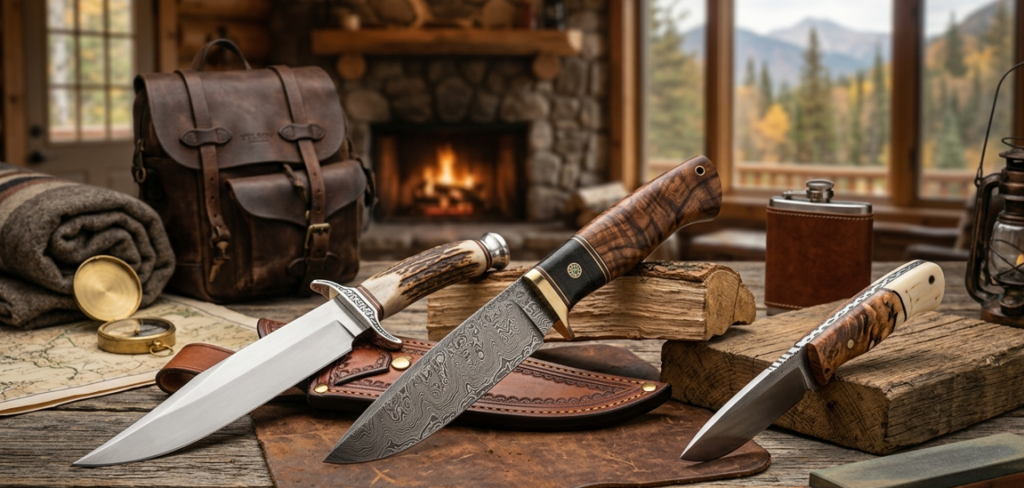
Damascus steel deserves a separate mention. It’s visually stunning — layers of folded steel create patterns that are literally unique to each blade. But here’s the honest trade-off: choosing Damascus for its aesthetics means accepting that maintenance is more demanding. The exposed carbon layers require regular oiling to prevent rust. For a collector who displays the knife as much as uses it, that’s a reasonable compromise. For someone who wants to throw it in a pack and forget about it, a modern tool steel is the smarter choice.
“When evaluating Damascus, ask the maker for the specific steel combination used in the billet. A mix of 1084 and 15N20 is a proven, high-performance pairing. Vague answers about ‘mystery steel’ are a red flag — beautiful pattern, poor performance.”
Who Are the Makers Worth Knowing?
The custom knife world has a clear hierarchy. At the top sit American Bladesmith Society (ABS) Master Smiths — fewer than 130 people in the world hold that title. A knife from an ABS Master Smith is a documented, verifiable credential of excellence.
A few names that consistently appear at the top of collector lists:
- Bob Loveless — his drop-point hunters from the 1970s–90s now sell for $8,000–$25,000 at auction. Loveless essentially defined the modern hunting knife aesthetic.
- Buster Warenski — known for ornate presentation pieces that blur the line between knife and sculpture. His work has been exhibited at the Smithsonian.
- Bark River Knives — a Michigan-based production house that occupies the sweet spot between handmade quality and accessibility, with prices from $200–$600.
For production knives with genuine collector appeal, William Henry (Oregon) produces limited-edition pieces with gemstone inlays and exotic handle materials. Their collaborations with artists sell out within hours of release. A William Henry B10 Lancet in mammoth ivory and Damascus retails around $1,800 — and holds resale value well.
How to Match the Knife to the Recipient
The right blade depends entirely on how the person actually spends time outdoors.
- For the hunter: A drop-point or clip-point fixed blade in the 4–5 inch range. Look for a full-tang construction — the blade steel runs the full length of the handle. This is the strongest possible configuration. A knife by Jason Knight (ABS Journeyman Smith) in CPM-3V with a stabilized wood handle runs $600–$900 and will outlast the owner.
- For the fly fisherman: A smaller, corrosion-resistant folder. The Benchmade 940 in S90V steel is a respected choice at $250. For a true luxury option, a custom piece from Tony Bose — a legend in the folding knife world — starts at $1,500 and has a waitlist measured in years.
- For the backcountry hiker or survivalist: A robust, full-tang fixed blade with a 5–6 inch blade. Fiddleback Forge (Alabama) makes some of the most respected working knives in this category, priced $350–$700. Their “Bushcrafter” model in A2 tool steel has been independently tested to process over 400 feet of wood without resharpening.
The Collector’s Comparison: Production Luxury vs. Custom Handmade
| Category | Production Luxury (e.g., William Henry) | Custom Handmade (e.g., ABS Master Smith) |
| Price Range | $500–$3,000 | $800–$25,000+ |
| Lead Time | In stock or 2–4 weeks | 6 months to 3+ years |
| Resale Value | Moderate, stable | High, often appreciates |
| Uniqueness | Limited edition runs | One of a kind |
| Practical Use | Yes, designed for use | Yes, but often displayed |
| Verifiable Credentials | Brand reputation | ABS certification, maker’s mark |
| Best For | Gift with immediate delivery | Long-term collector investment |
The Anatomy of Value: What You’re Actually Paying For
Think of buying a custom knife the way you’d think about commissioning a portrait from a serious painter versus buying a high-quality print. Both are beautiful. Both have real value. But one carries the irreplaceable mark of a specific human hand, a specific moment in time.
A custom blade at $2,000 reflects roughly 20–40 hours of skilled labor, $100–$300 in premium materials, and years of training. The maker’s signature — stamped into the ricasso (the flat section just above the handle) — is a permanent record of authorship. That mark is what makes it collectible.
“Before buying a custom knife as a gift, ask the maker for a certificate of authenticity and a photo of the blade at each stage of construction. This documentation doubles the knife’s story — and its long-term value.”
What to Look for Before You Buy
- Full tang construction for fixed blades — avoid hidden tang or rat-tail tang on anything above $300
- Maker’s mark stamped or etched into the blade — not just a sticker or certificate
- Handle material provenance — stabilized wood, fossil mammoth ivory, and Micarta all have different care requirements; confirm the recipient’s preference
- Sheath quality — a $1,500 knife in a $15 nylon sheath is a red flag about the maker’s overall standards
Does Rarity Actually Translate to Value?
Yes — but only when rarity is tied to documented quality. A knife is rare because few people can make it at that level, not because the maker decided to limit production arbitrarily.
Consider this: a 2019 collaboration between William Henry and artist Matteo Thun produced 25 pieces at $4,200 each. Within 18 months, secondary market prices reached $6,500–$7,000 — a 57% increase. The driver wasn’t scarcity alone. It was the combination of a recognized brand, a named artist, premium materials (mokume-gane fittings, fossil walrus ivory), and documented provenance.
Rarity without quality is just scarcity. Rarity with quality is an asset.
Where to Buy With Confidence
For custom knives, the Art Knife Invitational (San Diego) and Blade Show (Atlanta) are the two most respected venues in the United States. Both require makers to meet strict quality standards for participation. Buying directly from a maker at a show gives you the chance to examine the knife in person and speak with the person who made it.
For online purchases, Knife Art (knifeArt.com) and True North Knives are reputable dealers with return policies and authentication guarantees. Avoid auction platforms without seller verification for anything above $500.
The right knife, chosen with care, won’t just sit in a drawer. It will be carried, used, and eventually passed down — which is exactly what a gift worth giving should do.