
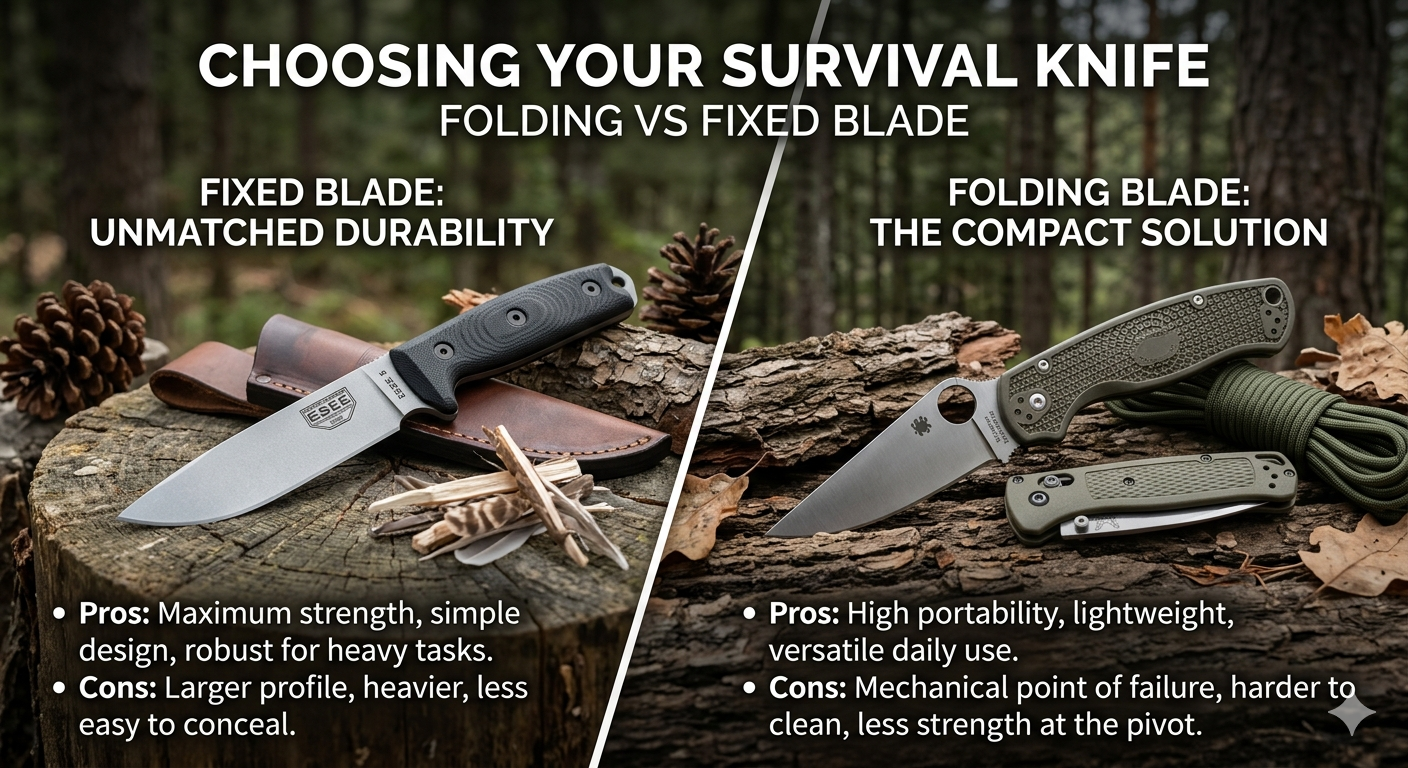
When you’re deep in the backcountry and something goes wrong, your knife is often the first tool you reach for. The question isn’t whether you need one — it’s which type will actually hold up when it matters.
Let’s break it down honestly.
The Core Difference: What You’re Actually Choosing Between
- A fixed blade is one solid piece of steel with a handle. No moving parts. No pivot point. No locking mechanism that can fail.
- A folding knife has a blade that collapses into the handle. It’s more compact. But that hinge is a mechanical weak point — full stop.
This single difference drives almost every other tradeoff between the two.
Does a Folding Knife Work for Survival?
Yes — with conditions. A quality folding knife with a reliable locking mechanism (like a liner lock or frame lock) handles most everyday tasks just fine: cutting cordage, preparing food, opening packages, basic first aid. For day hikes and urban carry, it’s often the smarter choice.
The problem shows up under stress. When you’re batoning wood, prying, or applying serious lateral force, a folder can flex at the pivot. Over time, that wears the lock. In cold weather, gloves make one-handed opening unreliable. Wet hands make it worse.
Real scenario: A hiker in the Cascades used a mid-range folding knife to process firewood during an unexpected overnight. After 20 minutes of hard use, the lock developed noticeable play. The knife still worked — but confidence dropped. That matters when you’re already stressed.
Why Fixed Blades Dominate in True Survival Situations
A fixed blade is structurally simple. Think of it like a crowbar versus an adjustable wrench — the crowbar has no moving parts to fail, and you can put your full weight on it without hesitation. That’s the fixed blade.
Full-tang construction — where the steel runs the entire length of the handle — means the blade and handle are one continuous piece. You can baton through hardwood, dig, pry, and apply force in any direction. The knife won’t fold on your fingers.
Deployment is also faster. No opening mechanism. Draw and use. In an emergency, that two-second difference is real.
The tradeoff: fixed blades are bulkier and harder to carry daily. A 4.5-inch fixed blade on your hip is noticeable. A folding knife in your pocket isn’t.
Head-to-Head: Key Criteria Compared
| Criterion | Fixed Blade | Folding Knife |
| Structural strength | High — no pivot point | Moderate — hinge is a weak point |
| Deployment speed | Instant | Slower (one or two-handed) |
| Carry convenience | Bulky, requires sheath | Compact, pocket-friendly |
| Cold/wet weather use | Reliable | Gloves complicate opening |
| Maintenance | Simple — clean and sharpen | More parts to clean and inspect |
| Legal carry | Often restricted | Generally more permissive |
| Best use case | Wilderness survival, camp tasks | EDC, hiking, light outdoor use |
What Does Your Actual Use Case Look Like?
This is the question most buyers skip. They buy based on looks or brand, then wonder why the knife doesn’t fit their needs. Ask yourself three things:
- Where will I use this most — urban, trail, or deep wilderness?
- How long will I be out — a day hike or a multi-week expedition?
- What tasks do I actually need a knife for — food prep, fire-making, shelter building, or all of the above?
If your answer is “mostly day hikes and car camping,” a quality folding knife — something like a Benchmade Griptilian or a Spyderco Paramilitary 2 — covers 90% of your needs. If you’re planning extended backcountry trips or building a serious survival kit, a fixed blade like the Mora Garberg or a Ka-Bar Becker BK2 is the more reliable foundation.
“Most people overthink blade length and steel type, then ignore the sheath. A fixed blade with a poor sheath is dangerous — it can shift, expose the edge, or slow your draw when you need it most. Before you buy, handle the sheath as much as the knife.”
Does Blade Steel Actually Matter for Survival?
It does — but not in the way most beginners think. The debate between stainless and carbon steel is real, but the practical gap is smaller than forums suggest.
- Stainless steel (like 440C or VG-10) resists corrosion well. Good for humid environments, coastal areas, or if you’re not diligent about maintenance. The tradeoff: it’s harder to sharpen in the field with basic tools.
- High-carbon steel (like 1095 or O1) sharpens faster and holds a working edge longer under hard use. The tradeoff: it rusts if you don’t dry and oil it. In the Pacific Northwest or Florida backcountry, that’s a real consideration.
A practical data point: In a 2019 field test by Blade Magazine, a 1095 carbon steel fixed blade maintained a functional cutting edge through 400 cuts on hemp rope before needing a touch-up. A comparable stainless folder required sharpening after 280 cuts under the same conditions.
The “Both” Option: Is Carrying Two Knives Practical?
Many experienced outdoorspeople carry both. A fixed blade for heavy work, a folder for detail tasks and everyday convenience. This isn’t overkill — it’s load distribution.
- Fixed blade on the hip or chest rig: batoning, shelter building, processing game.
- Folder in the pocket: food prep, first aid, quick cuts.
The combined weight of a Mora Companion (3.8 oz) and a mid-size folder (3-4 oz) is under half a pound. That’s a reasonable tradeoff for having the right tool for each job.
“In rescue scenarios, we see people with expensive knives they can’t operate under stress — frozen fingers, shaking hands, low light. Whatever you carry, practice deploying it one-handed, in the dark, with gloves on. If you can’t do that reliably, reconsider your choice.”
Under the Hood: What Most Buyers Don’t Check
A few details that separate functional survival knives from shelf decorations:
- Handle geometry under load: A handle that feels comfortable in a store can cause hot spots after 30 minutes of hard use. Look for a full guard or finger groove that prevents your hand from sliding onto the blade.
- Blade-to-handle ratio: For survival tasks, a blade between 4 and 6 inches hits the sweet spot. Under 3.5 inches limits batoning and heavy chopping. Over 7 inches adds weight without proportional utility for most users.
- Pivot screw torque (folders): A loose pivot is the first sign of wear. Most quality folders allow pivot adjustment with a Torx screwdriver. Check this before every extended trip.
- Sheath retention: A fixed blade sheath should hold the knife securely when inverted. If it falls out, it’s a liability.
- Grind type: A flat or Scandi grind is easier to sharpen in the field than a hollow grind. For survival use, simpler is better.
So Which One Should You Buy?
Choosing a fixed blade means accepting bulk in exchange for reliability under hard use. Choosing a folder means accepting a mechanical weak point in exchange for everyday convenience.
Neither is wrong. Both are compromises.
If you’re building a survival kit from scratch and can only pick one: go fixed blade, full tang, 4-5 inch blade, carbon or stainless depending on your climate. The Mora Garberg (around $90) and the Ka-Bar Becker BK2 (around $70) are honest, proven options that don’t require a $300 budget.
If you already carry a folder daily and want to add a survival-capable knife: a compact fixed blade as a secondary tool is the logical next step.
The best knife is the one you have with you, know how to use, and trust completely. Start there.
For further reading on blade steel properties and field performance, see the American Bladesmith Society’s published standards at americanbladesmith.com, and the gear testing methodology at outdoorgearlab.com.