
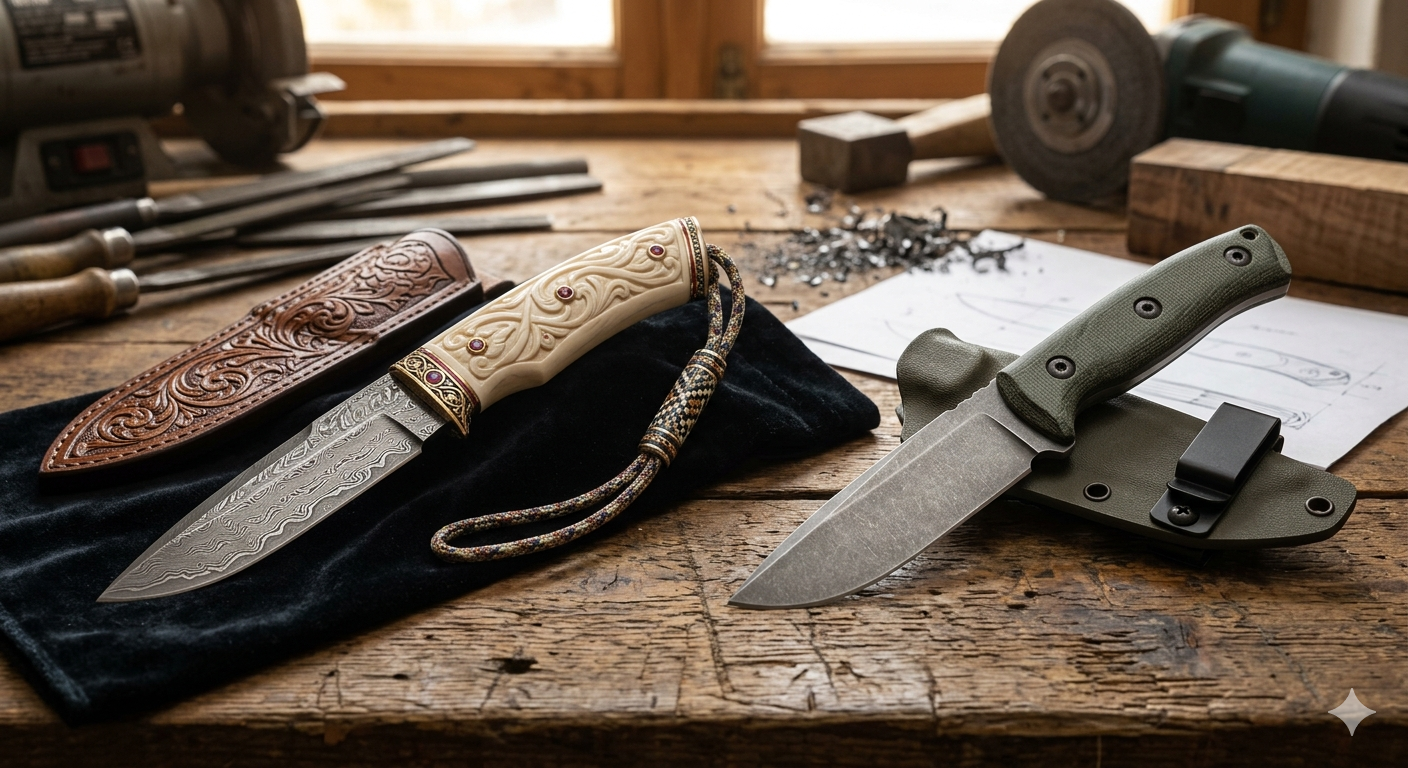
Pick up a custom knife by William Henry Studio and you’ll notice something immediately: it’s almost too beautiful to use. The handle is inlaid with mammoth ivory. The blade has a Damascus pattern that took days to forge. The price tag? Easily $2,000 or more. Now pick up a Benchmade 940. It opens smoothly, holds an edge through hard use, and costs around $200. Both are knives. But they exist in completely different worlds.
So where exactly does one world end and the other begin?
What Actually Separates an Art Knife from a Utility Knife?
The core difference isn’t about price or materials. It’s about intent.
A utility knife is designed to solve a problem — cutting rope, preparing food, surviving in the field. Every design decision serves that function. An art knife is designed to be experienced. The maker’s primary question shifts from “how well does it cut?” to “how does it make you feel when you hold it?”
That shift changes everything: the geometry, the materials, the time invested, and ultimately the value.
The Anatomy of an Art Knife
Art knives share a few consistent traits that set them apart from working tools.
- Non-standard materials: stabilized wood, fossil ivory, meteorite, mokume-gane (a Japanese layered metal technique), or hand-carved bone
- Labor-intensive blade work: hand-ground hollow grinds, carved fullers, engraved flats, or Damascus steel with 200+ layers
- Fit and finish measured in fractions: gaps between handle scales and bolsters are often under 0.005 inches — tighter than most production knives achieve even at their best
- Maker’s signature: art knives are almost always one-of-a-kind or extremely limited, signed by the maker
Makers like Buster Warenski, who spent over 5,000 hours on a single gold-inlaid dagger now housed in a museum collection, or Michael Walker, who pioneered the linerlock mechanism and later turned it into a canvas for sculptural expression, represent the pinnacle of this category.
Does an Art Knife Have to Be Useless?
No — and this is where the conversation gets interesting.
Many collectors assume art knives are purely decorative. That’s not accurate. A well-made art knife with a proper heat treat and a functional grind can outperform most production knives. The blade steel on a Bob Loveless drop-point — one of the most copied designs in knife history — was chosen for toughness and edge retention, not just looks.
Think of it like a hand-built Swiss watch. A Patek Philippe Nautilus keeps time just as accurately as a $50 Casio. But the Casio was engineered for reliability at scale. The Patek was engineered for both — and then taken further into craft. The function didn’t disappear. It became the foundation for something more.
The real question isn’t “can it cut?” It’s “was it built to be used, or built to be owned?”
Art Knives vs. Utility Knives: A Direct Comparison
| Criteria | Art Knife | Utility Knife |
| Primary intent | Aesthetic experience, collectibility | Functional performance |
| Production method | Handmade, one-of-a-kind or very limited | Production or semi-custom |
| Materials | Exotic, rare, often irreplaceable | Durable, practical, replaceable |
| Blade geometry | Often optimized for appearance | Optimized for cutting task |
| Price range | $500 – $50,000+ | $30 – $500 (most working knives) |
| Resale value | Appreciates with maker’s reputation | Depreciates with use |
| Typical owner | Collector, investor, enthusiast | Outdoorsman, chef, tradesperson |
| Risk of use | High — damage is irreversible | Low — designed for hard use |
How Do You Evaluate an Art Knife’s Value?
Valuing an art knife follows a logic closer to fine art than to hardware.
- Maker’s reputation and exhibition history — Has the knife been shown at the Blade Show in Atlanta or the Art Knife Invitational? These are the two most respected venues in the U.S. for high-end custom knives. A ribbon from either adds measurable value.
- Material provenance — Mammoth ivory from a documented Siberian excavation, or Damascus steel forged by a named smith, carries more value than similar-looking materials without a paper trail.
- Technical execution — Collectors and judges look at plunge line consistency, handle-to-blade fit, and symmetry. A single uneven bevel can drop a knife’s perceived value by 20–30% among serious buyers.
- Condition and originality — Any modification, sharpening, or cleaning with the wrong product can permanently reduce value. Unlike utility knives, art knives are often stored in climate-controlled cases.
“Never clean an art knife handle with oil-based products unless you know exactly what the material is. Stabilized wood and fossil ivory react differently to the same treatment. One wrong product and you’ve altered a surface that took the maker 40 hours to finish.”
The Gray Zone: When Function and Art Overlap
Some of the most compelling knives exist in neither category..
Consider the work of Tashi Bharucha, a maker known for tactical folders that combine aggressive ergonomics with flawless fit and finish. His knives can be carried and used — but they’re also collected and traded at prices above $1,500. Or look at the Strider SMF: a fixed blade built for military use that developed a cult following among collectors who never deployed it once.
A collector in Texas once bought a Darrel Ralph custom folder specifically for EDC use. After six months of daily carry, the knife developed a patina on the titanium frame that actually increased its value — because it documented real use by a known owner. The knife became more interesting, not less.
Choosing an art knife for daily use means accepting a real trade-off: you gain the pleasure of carrying something extraordinary, but you accept the risk of irreversible wear on a piece that may never be replaceable.
What Should You Actually Buy?
If you’re building a collection focused on investment and appreciation, prioritize maker reputation, exhibition credentials, and material documentation. The American Bladesmith Society (ABS) and the Knifemakers’ Guild both maintain maker registries that help verify credentials — a useful starting point at americanbladesmith.com.
If you want something beautiful that you can actually use, look at the middle ground: semi-custom makers who produce limited runs with upgraded materials but functional geometry. Makers like Jason Clark or Chad Nichols (known for his Damascus steel) offer pieces that perform well and hold value without the fragility of a true art knife.
“The biggest mistake new collectors make is buying an art knife based on photos alone. Handle materials photograph beautifully but feel completely different in hand. If you’re spending over $1,000, always handle the knife first — or buy from a maker with a documented return policy.”
Five Things Most Buyers Don’t Know
Blade geometry matters more than steel in art knives. A perfectly ground 440C blade will outcut a poorly ground CPM-154 blade every time. Steel choice matters less than execution.
Damascus steel is not inherently stronger. The pattern-welded steel used in most art knives is chosen for visual impact. High-layer Damascus (300+) can actually be more brittle than a mono-steel blade of equivalent hardness.
Most art knife handles are not waterproof. Fossil ivory, stabilized wood, and natural bone all react to humidity. The Smithsonian Institution recommends storing organic-handled knives at 45–55% relative humidity to prevent cracking.
Engraving reduces structural integrity slightly. Deep relief engraving on bolsters removes metal. On a working knife, this matters. On an art knife displayed in a case, it doesn’t — but it’s worth knowing.
The resale market for art knives is illiquid. Unlike production knives with established secondary markets on platforms like BladeForums, selling a high-end art knife can take months and requires access to the right collector network.
Where Does the Line Actually Fall?
There’s no official boundary. But here’s a practical test: ask yourself what happens if the knife gets scratched.
If the answer is “I’d sharpen it and keep going,” you have a utility knife. If the answer is “I’d be devastated,” you have an art knife. And if the answer is somewhere in between — you’ve found the most interesting place in the entire hobby.
That middle ground is where the best conversations happen. And often, where the best knives live.