
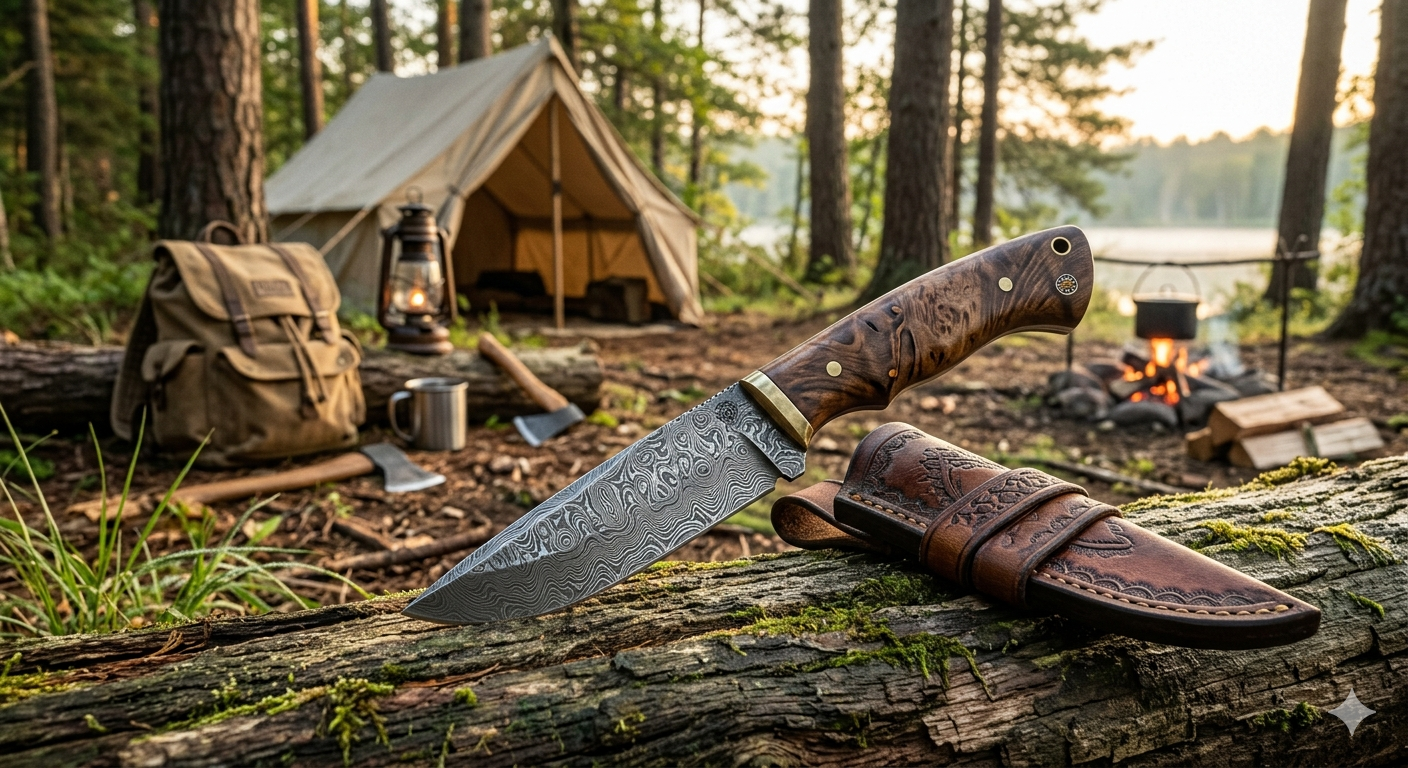
If you’ve spent any real time in the field, you know that a knife isn’t just a tool — it’s the one piece of gear you reach for constantly. Skinning game, cutting cordage, preparing food, splitting kindling. A bad knife slows you down. A great one becomes invisible — it just works.
So the question is fair: does a custom hunting knife actually perform better than a quality production blade, or are you mostly paying for the story behind it?
Let’s break it down honestly.
What Actually Makes a Custom Knife Different?
A custom knife is built by a single maker, start to finish, for a specific purpose — or for you specifically. That’s not marketing language. It has real consequences for how the knife performs.
Production knives are made to a price point. Even good ones — like a Benchmade or a Buck 119 — involve compromises in steel heat treatment, handle geometry, and blade grind, because the manufacturer needs to hit a margin across 50,000 units. A custom maker heat-treats one blade at a time, often in a small forge, and can dial in the hardness to within a point or two on the Rockwell scale.
That matters. A blade hardened to HRC 61-62 in a high-carbon steel like 1084 or 80CrV2 holds an edge roughly 30-40% longer under field use than a comparable production blade at HRC 57-58 — the typical range for budget to mid-tier factory knives.
Does Better Steel Actually Change Anything in Camp?
Here’s a practical scenario worth considering.
A hunter from Montana spent three seasons using a $90 production knife for elk processing. After field dressing and quartering a 600-pound bull, he’d touch up the edge twice and still finish with a blade that felt dull. He switched to a custom drop-point in O1 tool steel, hardened to HRC 62 by the maker. Same job, same conditions. One light strop mid-process. Done.
That’s not anecdote for its own sake — it illustrates a real pattern. When steel quality and heat treatment are optimized together, edge retention improves in ways you feel immediately in the field.
Custom vs. Production: A Direct Comparison
| Feature | Custom Knife | Quality Production Knife |
| Steel quality | Maker’s choice, often premium | Standardized, cost-controlled |
| Heat treatment | Individual, precise | Batch process |
| Handle fit | Tailored to hand size/grip | One-size-fits-most |
| Blade geometry | Purpose-built | General-purpose compromise |
| Price range | $200–$800+ | $50–$200 |
| Lead time | 3–12 months | Immediate |
| Repairability | Direct maker contact | Warranty service only |
| Resale value | Often appreciates | Depreciates |
The production knife wins on price and availability. No question. But choosing a production knife for the sake of cost means accepting a blade geometry and handle shape designed for an average hand doing average tasks — not your hand, doing your specific work.
“Most campers don’t realize that handle geometry affects fatigue more than blade steel. A handle that doesn’t fit your grip will tire your hand in 20 minutes of processing work. That’s the first thing I ask a client — not what steel they want, but how they hold a knife and what they’re cutting.”
Is the Price Gap Justified for Regular Campers?
Think of it like buying boots. A $60 pair from a big-box store fits most feet adequately. A $300 pair from a specialty cobbler fits your foot — your arch, your width, your gait. After a 10-mile day, the difference isn’t subtle.
A custom knife works the same way. The “fit” isn’t just comfort — it’s efficiency. A blade ground specifically for skinning game (thin behind the edge, with a slight hollow) performs differently than a general-purpose blade trying to do the same job.
That said, the math only works if you use the knife hard and often. If you camp three weekends a year and mostly cut food and rope, a well-made production knife — a Mora Garberg, a Ka-Bar Becker BK2 — will serve you completely. Spending $400 on a custom blade for occasional use is like buying a race-tuned truck to drive to the grocery store.
What Are the Real Downsides of Going Custom?
Choosing a custom knife ради superior performance means accepting real trade-offs.
- Wait time. Reputable makers have backlogs of 6–18 months. You won’t get the knife when you want it.
- No returns. If the maker misunderstood your needs, adjustments cost time and sometimes money.
- Fragility of the relationship. If your maker retires or stops taking commissions, future repairs become complicated.
- Upfront cost. $300–$600 is the realistic entry point for a genuinely well-made custom hunting knife from an established maker.
The obverse side of that last point: custom knives from known makers hold or increase their value. A production knife loses 40-60% of its value the moment you use it. A custom from a respected ABS Journeyman or Master Smith often sells used for close to purchase price.
Field Notes: What Custom Knife Users Actually Report
Campers and hunters who’ve made the switch consistently report three things:
- They sharpen less often — edge retention is noticeably better
- Their hand fatigues less during extended processing work
- They stop carrying backup blades
That third point is underrated. Simplifying your kit has real value when you’re packing weight.
“Don’t commission a custom knife until you’ve used at least three different production knives and know exactly what bothers you about each one. The best brief you can give a maker is: ‘This blade was too thick behind the edge, this handle was too short, and this steel chipped on bone.’ Specifics produce better knives.”
Under the Hood: Facts Most Buyers Don’t Know
A few things worth knowing before you spend money:
- Differential heat treatment (hardening only the edge, leaving the spine softer) is almost never done on production knives but is standard practice among serious custom makers. It produces a blade that’s hard where it needs to be and tough where it needs to flex.
- Handle material affects grip in wet conditions more than texture does. Stabilized wood and G10 outperform rubber in cold, wet gloves — a fact that matters in November elk camp.
- The ABS (American Bladesmith Society) certifies makers at Journeyman and Master levels through standardized performance tests. A Master Smith’s blade must cut a free-hanging rope, chop through 2×4 lumber, and flex 90 degrees without breaking — all before certification. ABS certification standards are publicly available and worth reviewing before commissioning a knife.
- Carbon steel vs. stainless is a real debate in custom work. Carbon steels like 1084 and W2 are easier to sharpen in the field with a simple stone. Stainless like CPM-154 resists corrosion better in coastal or wet environments. Neither is universally better — it depends on where you hunt.
For more on steel metallurgy and performance testing, the Knife Steel Nerds database is one of the most reliable technical resources available.
So — Should You Buy One?
If you spend 20+ days a year in the field, process your own game, and have used enough production knives to know what frustrates you about them — yes. A custom knife will pay back the investment in performance and longevity over 5–10 years of hard use.
If you’re newer to hunting or camp a few times a year, start with a quality production knife. Learn what you actually need. Then commission something built for exactly that.
The knife that fits your hand, your tasks, and your environment will always outperform the knife that fits everyone else’s.