
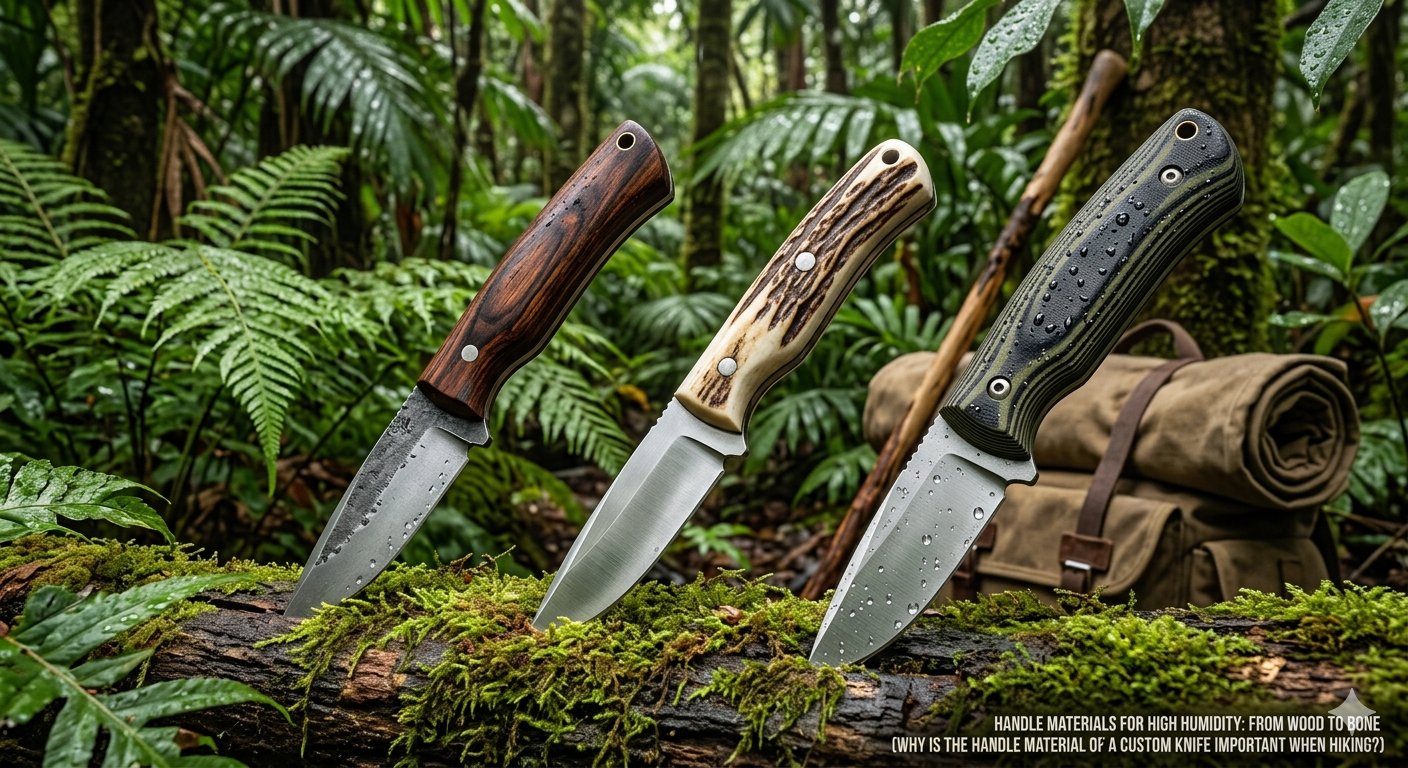
When you’re three days into a backcountry trip, soaked from a river crossing, and you need your knife right now — the last thing you want is a handle that’s swollen, slippery, or cracked. The blade matters. But the handle is what connects you to it.
Choosing a handle material for a custom knife isn’t about looks. It’s about how that material behaves when it’s wet, sweaty, cold, and used hard. Here’s what you need to know before you order.
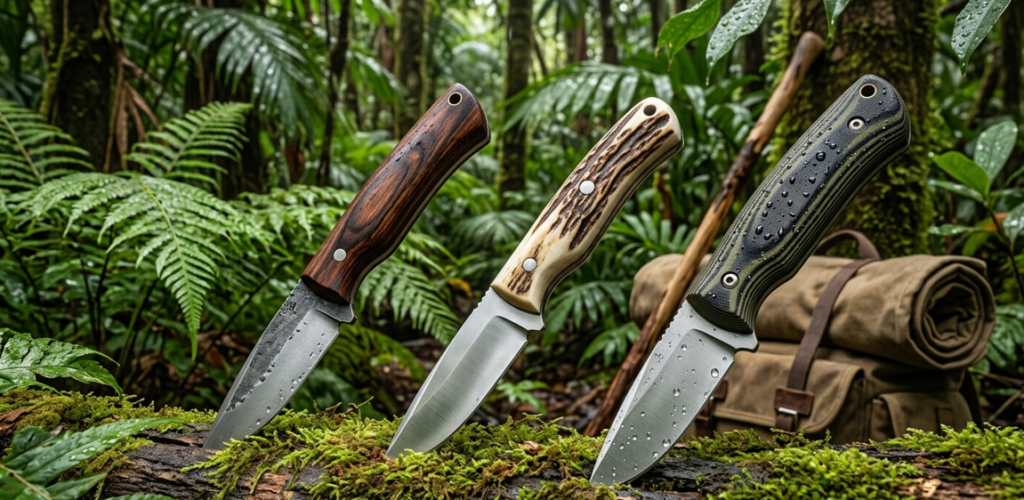
Why Does Humidity Destroy Some Handles Faster Than Others?
Think of handle materials like hiking boots. A leather boot looks great and feels broken-in — but soak it in a creek every day for a week, and it warps, stiffens, and starts to fall apart. A synthetic boot sheds water and keeps its shape. The same logic applies to knife handles.
Moisture causes three main problems:
- Swelling and warping (especially in organic materials)
- Loss of grip when wet
- Bacterial growth and rot over time
The material you choose determines which of these problems you’ll face — and how badly.
Wood: Beautiful, But Demanding
Stabilized wood is the most common handle material on custom knives. And for good reason — it looks exceptional and feels natural in the hand.
Unstabilized wood is a problem in high humidity. Wood absorbs moisture, expands, and can crack as it dries. A handle that fits perfectly in a dry workshop can loosen on the blade tang after a week in the Pacific Northwest rain. Some makers report up to 3–4% dimensional change in untreated hardwoods after prolonged moisture exposure — enough to affect fit and feel.
Stabilized wood is a different story. The process involves vacuum-impregnating the wood with resin under pressure, filling every pore. The result is a material that resists moisture absorption by up to 90% compared to raw wood, according to data from stabilization suppliers like Cactus Juice. It holds its shape, doesn’t swell, and maintains grip.
The tradeoff: stabilized wood costs more and adds weight. And even stabilized wood can degrade if the finish is scratched and left untreated for months.
“If someone orders a wood-handled knife for serious wet-weather use, I always ask: are you willing to oil it twice a year? If the answer is no, I steer them toward G-10 or Micarta. Stabilized wood is excellent — but it’s not zero-maintenance.”
Micarta and G-10: The Workhorses
These two synthetic materials dominate the practical end of custom knife handles — and for good reason.
Micarta is made from layers of linen, canvas, or paper soaked in resin and compressed under heat. It’s warm to the touch, develops a slight patina over time, and — critically — gets grippier when wet. That’s not a typo. The texture opens up slightly with moisture, giving you more friction when you need it most.
G-10 is fiberglass laminate. It’s harder than Micarta, more resistant to chemicals, and dimensionally stable across a wide temperature range. It doesn’t absorb water at all. The downside: it can feel cold and industrial in the hand, and some hikers find it uncomfortable on long cutting tasks.
Comparison Table: Handle Materials for Wet Conditions
| Material | Wet Grip | Moisture Resistance | Weight | Maintenance | Best For |
| Stabilized Wood | Good | High | Medium | Low-moderate | Versatility, aesthetics |
| Raw Wood | Poor (wet) | Low | Light | High | Dry climates only |
| Micarta | Excellent | Very High | Medium | Minimal | All-weather use |
| G-10 | Very Good | Excellent | Light-medium | None | Technical/hard use |
| Bone | Poor (wet) | Low | Light | High | Dry conditions |
| Synthetic Bone | Good | High | Light | Low | Moderate humidity |
| Carbon Fiber | Good | Excellent | Very Light | None | Ultralight builds |
What About Bone?
Bone handles have a long history. They look traditional, feel unique, and age with character. But bone is a porous organic material. It absorbs moisture, can crack under freeze-thaw cycles, and becomes slippery when wet.
Picture this: a hiker in the Cascades orders a custom knife with a stag bone handle. First season, it looks great. By the second summer, after repeated rain exposure and drying, the handle has developed a hairline crack near the bolster. The fit loosens. The knife becomes unsafe for hard tasks.
Choosing bone for wet-environment hiking means accepting that tradeoff directly: you get a beautiful, historically resonant handle, but you’ll need to store it dry, oil it regularly, and accept a shorter service life in harsh conditions. For a camp knife used occasionally in moderate weather — fine. For a primary tool on a 14-day wet-season trip — not the right call.
Does Handle Thickness Change How Moisture Affects Grip?
Yes, and it’s worth thinking about before you spec your custom knife.
Thinner handles concentrate grip pressure on a smaller surface area. When that surface is wet and smooth (like polished bone or lacquered wood), your hand has less margin for error. Thicker handles with textured surfaces — like a G-10 handle with jimping or a Micarta handle with a rough finish — distribute grip load and maintain control even with wet, cold hands.
“I’ve seen people drop knives during fish cleaning because the handle was too smooth and too thin. In cold water, your grip strength drops by 20–30%. Your handle needs to compensate for that, not assume your hands are dry and warm.”
The Field Reality: What Happens After 10 Days in the Rain
Here’s what sustained humidity actually does to different materials over a typical 10-day backcountry trip with daily rain and river crossings:
- Unstabilized wood — visible swelling by day 3–4, possible loosening at the guard by day 7
- Stabilized wood — holds shape, minor surface darkening, no structural change
- Micarta — no change, grip improves slightly
- G-10 — no change at all
- Raw bone — surface becomes tacky then slippery, micro-cracking risk in cold nights
Under the Surface: What Most Reviews Don’t Tell You
A few facts that rarely make it into mainstream knife content:
- Micarta’s grip improvement in wet conditions is measurable: independent grip-force testing by knife forums like Bladeforums has shown up to 15% higher friction coefficient when wet versus dry on canvas Micarta.
- G-10 was originally developed for printed circuit boards — its moisture resistance is engineered to military-grade tolerances, not just “pretty good.”
- Bone’s porosity varies significantly by animal source and preparation method. Stabilized synthetic bone (resin-cast) behaves more like Micarta than natural bone.
- Carbon fiber handles, while excellent in moisture resistance, can delaminate if the layup quality is poor — always ask your maker about the fiber orientation and resin system used.
So, Which Material Should You Choose?
For most hikers dealing with real humidity — rain, sweat, river crossings — the answer is Micarta or stabilized wood, depending on your priorities.
- If you want zero maintenance and maximum grip reliability: Micarta or G-10.
- If you want a handle that feels alive in the hand and you’re willing to do basic upkeep: stabilized wood.
- If you’re drawn to bone for its character: use it for a dry-climate knife, not your primary wet-weather tool.
The handle is the interface between you and the blade. In the field, that interface needs to work every time — not just when conditions are ideal. Choose accordingly.