
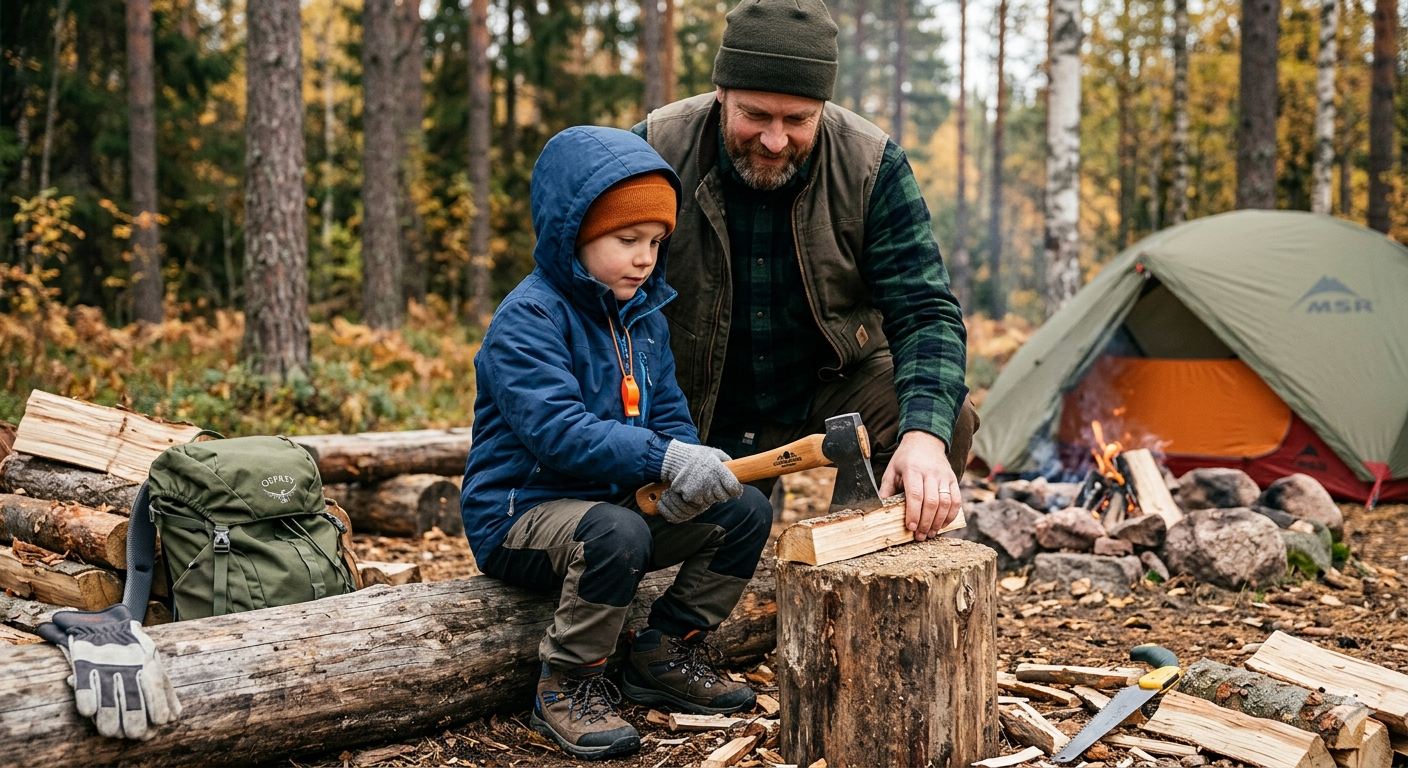
Every parent who has handed a child a pocket knife or a hatchet for the first time knows that feeling. You want them to learn. You also want them to be safe. The tension between those two things is real.
The good news: you don’t need a long list of rules. You need one clear principle that kids can actually remember and apply on their own.
That’s what the Rule of Tools is about.
What Is the Rule of Tools?
The Rule of Tools is simple: a tool is only in your hand when you are actively using it. The moment you stop using it, it goes back to its safe place — sheathed, closed, set down properly, or handed back to an adult.
That’s it. One rule. But it covers almost every situation you’ll encounter outdoors.
It applies to a folding knife, a fishing hook, a garden trowel, a hatchet, a trekking pole, or even a heavy flashlight. If you’re not using it right now, it’s not in your hand.
This rule works because it’s concrete. Kids don’t do well with abstract instructions like “be careful” or “respect your tools.” Those phrases mean nothing to a seven-year-old who’s excited about a campfire. But “put it away when you’re done” — that they can follow.
Why Does This Habit Matter So Much?
Most outdoor injuries involving tools happen during transitions — not during use. A child trips while carrying an open knife. Someone reaches into a bag where a hook isn’t capped. A hatchet gets left blade-up in the grass.
According to the American Academy of Pediatrics, lacerations are among the most common outdoor injuries in children ages 5–14, and a significant portion involve hand tools or sharp implements used during recreational activities.
The Rule of Tools directly addresses the transition problem. It creates a clear behavioral boundary: active use versus everything else.
There’s a deeper benefit too. When a child learns to put a tool away consistently, they’re building a mental habit that transfers. They start to see tools as objects that deserve attention — not toys to be dropped and forgotten. That shift in mindset is the foundation of real outdoor competence.
How Do You Teach It by Age?
Not every child is ready for the same tool at the same age. But the Rule of Tools applies at every level. What changes is the tool, not the principle.
Here’s a practical breakdown:
| Age Range | Appropriate Tools | Adult Role |
| 4–6 years | Blunt garden tools, fishing bobbers, magnifying glass | Full supervision, demonstrate the rule every time |
| 7–9 years | Folding knife (with safety lock), small trowel, kid’s hatchet | Side-by-side practice, verbal reminders |
| 10–12 years | Fixed-blade knife, fishing hooks, camp saw | Spot-check supervision, child leads |
| 13+ years | Full camp toolkit | Independent use, adult available |
The key insight here: giving a 10-year-old a fixed-blade knife before they’ve internalized the Rule of Tools is a setup for an accident. But a 7-year-old who consistently sheathes their folding knife without being reminded is ready for more responsibility. Age is a guideline. Behavior is the real indicator.
What Does Teaching This Look Like in Practice?
Start before you’re outdoors. At home, at the kitchen table, before the camping trip. Show the child the tool. Demonstrate the rule. Let them practice the motion — open, use, close, put away — until it feels automatic.
Think of it like teaching a child to buckle a seatbelt. You don’t explain the physics of a car crash. You just repeat the action until it becomes reflex. The Rule of Tools works the same way. Repetition builds the habit before the stakes are high.
Once you’re outside, narrate your own behavior out loud. “I’m done cutting, so I’m closing my knife now.” Children learn by watching adults more than by listening to instructions. When they see you follow the rule every single time, it stops being a rule and becomes just how things are done.
“The biggest mistake parents make is correcting a child after something goes wrong. The habit has to be built before the moment of risk. Practice the put-away motion at home, dry, with no pressure. By the time you’re in the field, it should be automatic.”
What Happens When Kids Break the Rule?
They will. That’s not failure — it’s the learning process.
When a child leaves a tool out or carries it carelessly, the response matters. Don’t take the tool away permanently. That teaches fear, not responsibility. Instead, stop the activity, reset, and repeat the correct behavior together.
Here’s a real pattern that works: A father on a three-day backpacking trip with his 9-year-old noticed his son walking between campsites with an open folding knife, distracted by something in the trees. He didn’t yell. He said, “Hey — what’s the rule?” The boy stopped, closed the knife, and put it in his pocket. They kept walking. By day three, the father hadn’t needed to say it once.
That’s the goal. Not perfect compliance on day one. Internalized behavior by the end of the trip.
The Harder Question: When Should You Say No?
Sometimes the right answer is not yet. Choosing to give a child more responsibility than they’re ready for — even with good intentions — creates risk without building competence.
The signs a child isn’t ready:
- They lose focus quickly during tool use
- They’ve left tools out repeatedly after reminders
- They treat tools as toys (throwing, tapping, playing)
Choosing to wait for safety means giving up some of the “cool dad/mom” moment. That’s the honest trade-off. But a child who earns a tool at 10 after demonstrating readiness will handle it better than one who received it at 8 before they were ready.
“Outdoor confidence in kids isn’t built by giving them harder challenges earlier. It’s built by letting them succeed at the right challenge at the right time. Tools are no different.”
One Rule, Repeated Consistently, Changes Everything
The field notes on this are clear:
- Children who learn tool rules through consistent repetition — not one-time lectures — retain safe habits longer
- Outdoor programs that use single, memorable behavioral rules report fewer tool-related incidents than those using multi-step safety checklists
- The American Camp Association recommends age-appropriate tool introduction paired with explicit behavioral expectations as a core component of outdoor youth programming
The Rule of Tools isn’t about limiting kids. It’s about giving them a framework they can actually use. One clear rule, practiced consistently, builds the kind of outdoor competence that lasts a lifetime.
Start simple. Start early. And follow the rule yourself, every time.